
BP Interpreting Days ’27 :: An eventfor interpreters by BP Translation Conferences :: Online :: 18-21 January 2027
A BP conference for interpreters
Skills :: Specialisations :: Market :: Technology
by BP Translation Conferences
BP Interpreting Days ’27
Tentative in-person conference :: We’ll do it if there’s sufficient interest
Countdown to BPID27 online
Day(s)
:
Hour(s)
:
Minute(s)
:
Second(s)
Conference format
Workshops and shorter sessions online
Really sorry about cancelling Valencia 🙁
Muiltilingual event
In addition to English, there’s room for sessions or workshops in other languages as well.
Apply as a speaker
German/French/Italian/Spanish
Registration
now open
Programme
published gradually
BPID27 online
18-21 January 2027
Speaker application
for sessions in German / French / Italian / Spanish
BP Interpreting Days :: Registration
47€ to 87€ :: Details
- Full access to all sessions and workshops
- Networking sessions
- Recordings
- Certificate of attendance
- Higher price from 1 December
- +VAT in certain cases (if you’re from the EU without a VAT number)
67€ to 137€ :: Details
- Full access to all sessions and workshops
- Networking sessions
- Recordings
- Certificate of attendance
- 300+ recordings from previous events*
- Higher price from 1 December
- +VAT in certain cases (if you’re from the EU without a VAT number)
- *100 recordings available immediately,
- 220 recordings available from January
- List of videos: BPconf.com/videos
Differentiated prices
We apply geographically differentiated pricing for our online events, to make them more affordable for colleagues who live lower income countries.
People in Argentina pay less than in France, for example.
You will see the price for your country on the Cart page.
VAT in certain cases
Online events are regarded and taxed as ‘digital services’.
- EU, B2B (if you have a VAT number): no VAT
- EU, B2C (you don’t have a VAT number): your country’s VAT rate applies (but we also give you a 10% discount off the net price)
- Hungary: Hungarian VAT rate applies
- Outside the EU: no VAT
Access details
Our online events take place on Zoom.
You need to have a Zoom account (a free one is OK).
You’ll receive access links 7-10 days before the event.
Recordings
You’ll receive links to the recordigs 1-2 days after the event.
Recordings will be available on Zoom, and you’ll need to log in to your Zoom account.
Earlier recordings (VIP ticket)
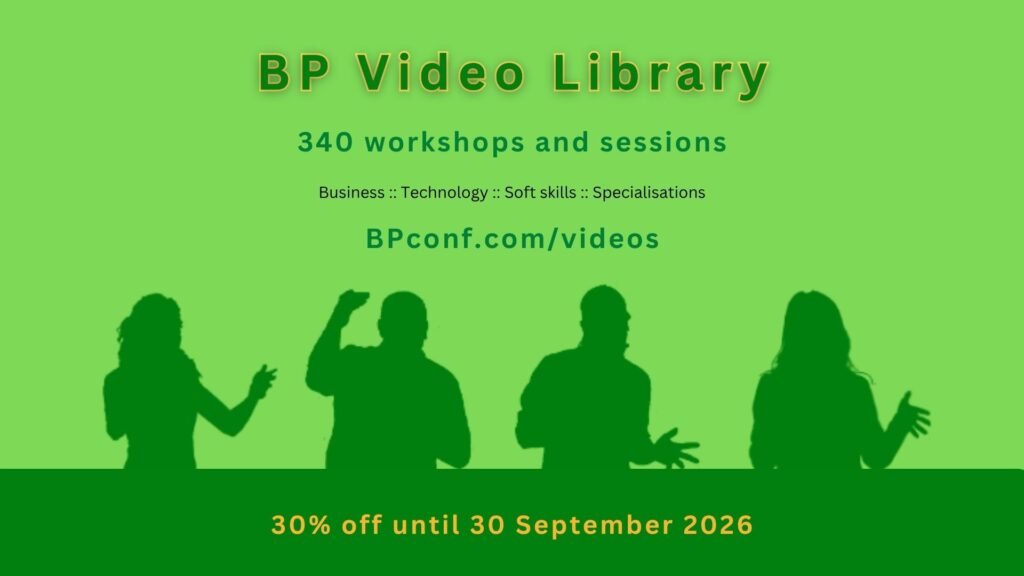
You can see a list of all 300+ videos on BPconf.com/videos
After your pruchase of a VIP ticket, you’ll receive an email with information on how to access the videos.
About 100 are available immediately on Zoom.
The remaining 200+ are currently being migrated to a new streaming platform, and will be available from January on our new website, BPmeet.com.
Cancellation policy
All sales are final.
If you cannot attend the online event and you won’t be able to watch the recordings either, and you wish to cancel your attendance before 4 January, you will receive a store credit.
In this case, the amount of the store credit is the net amount (without VAT) of a Premium ticket, or the 70% of the net amount of a VIP ticket.
You can use the store credit for our future events.
Payment in 2 installments
You may choose to pay your ticket in two equal installments.
In this case, you’ll be taken to another website, Partial.ly, where you’ll need to sign a contract.
First half due at the time of purchase; the second half is due 30 days later.
Please note there’s a 2% fee.
Up to 50% discount for students
We offer a 40% discount for full-time students of interpreting studies. You must be under 30 years old on the first day of the event.
50% discount if at least 3 students apply together from the same university.
Apply below.
Higher prices from 1 December
Please note that prices will be 25-30% higher from 1 December 2026.
Offer for associations
If your association or organization buys at least 5 tickets on the same invoice, you get a 30% discount. After this, you get a coupon code that gives 30% discount for each individual purchase for your members.
If your association or organization buys at least 10 tickets on the same invoice, you get a 40% discount. After this, you get a coupon code that gives 40% discount for each individual purchase for your members.
In addition, your association/organization will be mentioned on this page as a partner.
Programme
Sessions
About the session
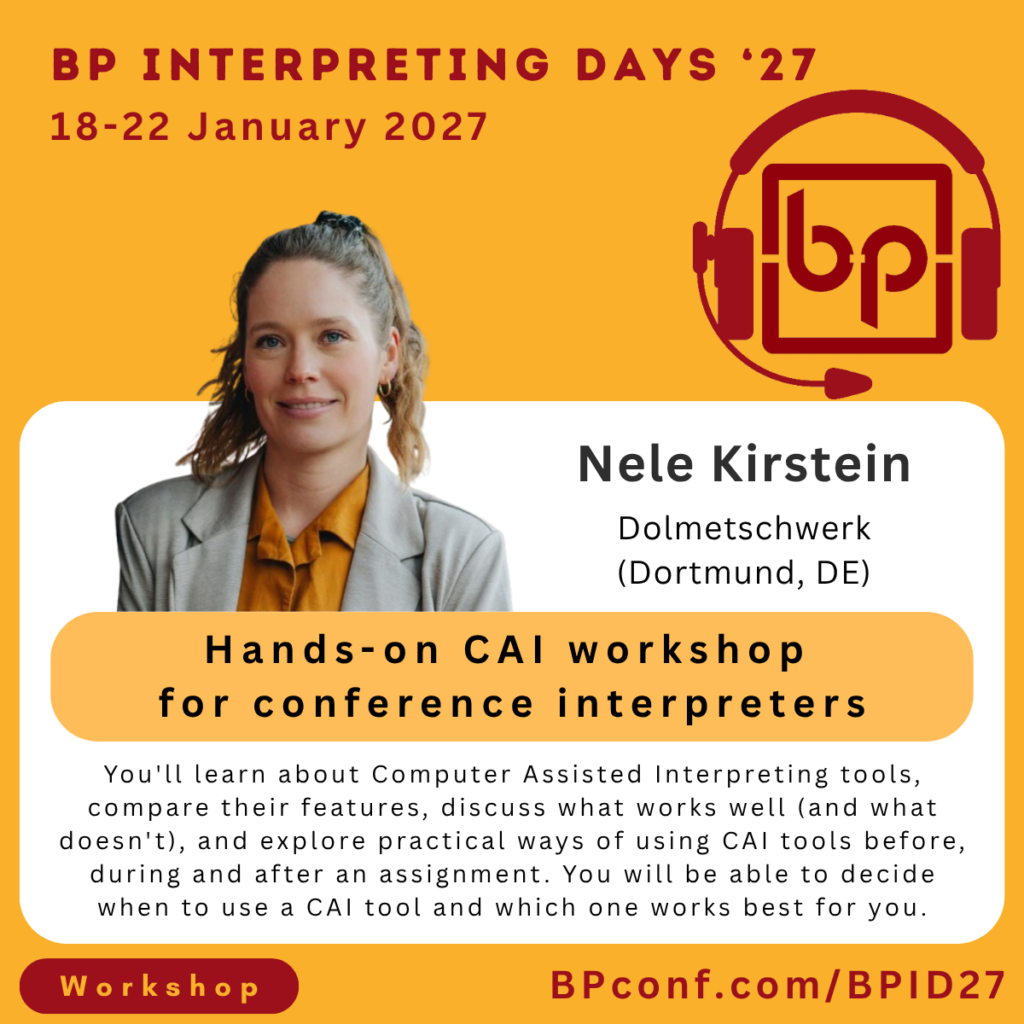
Computer-Assisted Interpreting (CAI) tools have become increasingly sophisticated, offering features such as terminology management, real-time terminology extraction, speech recognition, and AI-powered support. This interactive workshop gives participants the opportunity to explore a range of current CAI solutions through guided exercises based on realistic conference interpreting scenarios. Together, we will compare tools, test key features, and discuss practical workflows for preparation and live interpreting. Participants will leave with hands-on experience, a better understanding of each tool's strengths and limitations, and concrete strategies for integrating CAI technology into their professional practice.
About the speaker
Nele Kirstein has worked as a freelance conference interpreter and interpreting lecturer at TH Köln University of Applied Sciences for seven years. She works with English and German and is a member of both AIIC and VKD in Germany. In 2025/26 Nele contributed to the development of the AI4Terps online learning platform, which teaches interpreters all they need to know about AI, including CAI tools. Nele has recently started her PhD on AI and interpreting at TH Köln and Universität Mainz/Germersheim.
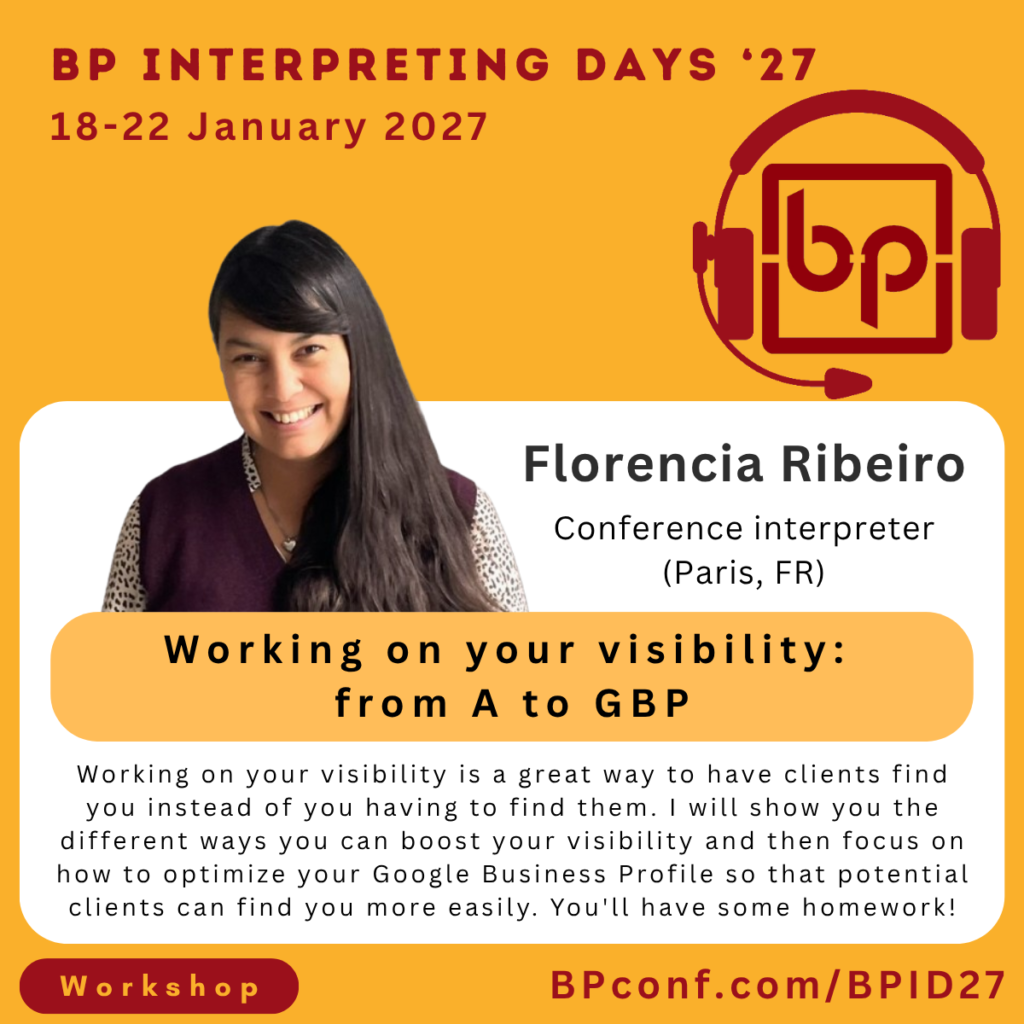
About the session
One of my best clients in 2026 came from… Claude. Though I don't know exactly how it happened, one thing's for sure: my online presence helped me get noticed. Since I started freelancing in 2024, I have put a lot of effort into my visibility: creating my visual identity, website, business cards, LinkedIn profile, Google Business Profile… All those small bricks of visibility have helped me build an online presence. And I want to share all of that with you.
Over the first two hours, we'll explore the different ways you can build your visibility as an interpreter. Then, during the final hour, we'll work on YOUR Google Business Profile. I'll ask you to create one and bring some materials in advance, and then we'll look at them together to see how we can improve them. Ready to work on your visibility and make it easier for potential clients to find you?
About the speaker
Florencia Ribeiro is a Spanish conference interpreter based in Paris. Born and raised in Argentina, she was adopted by France in 2015 and works between Spanish, English and French. Having studied at UMSA, Université de Lorraine and London Metropolitan University, her most recent qualification is a postgraduate diploma in conference interpreting from London Met.
Since starting her freelance career in 2024, she has been focusing on building her online visibility to attract more clients. After attending many courses, reading a lot of articles and watching way too many tutorials, she started building her online presence, one step at a time. Now, she wants to share what she's learnt with fellow interpreters, helping them save time, avoid the headache of figuring everything out on their own, and make it easier for potential clients to find them.
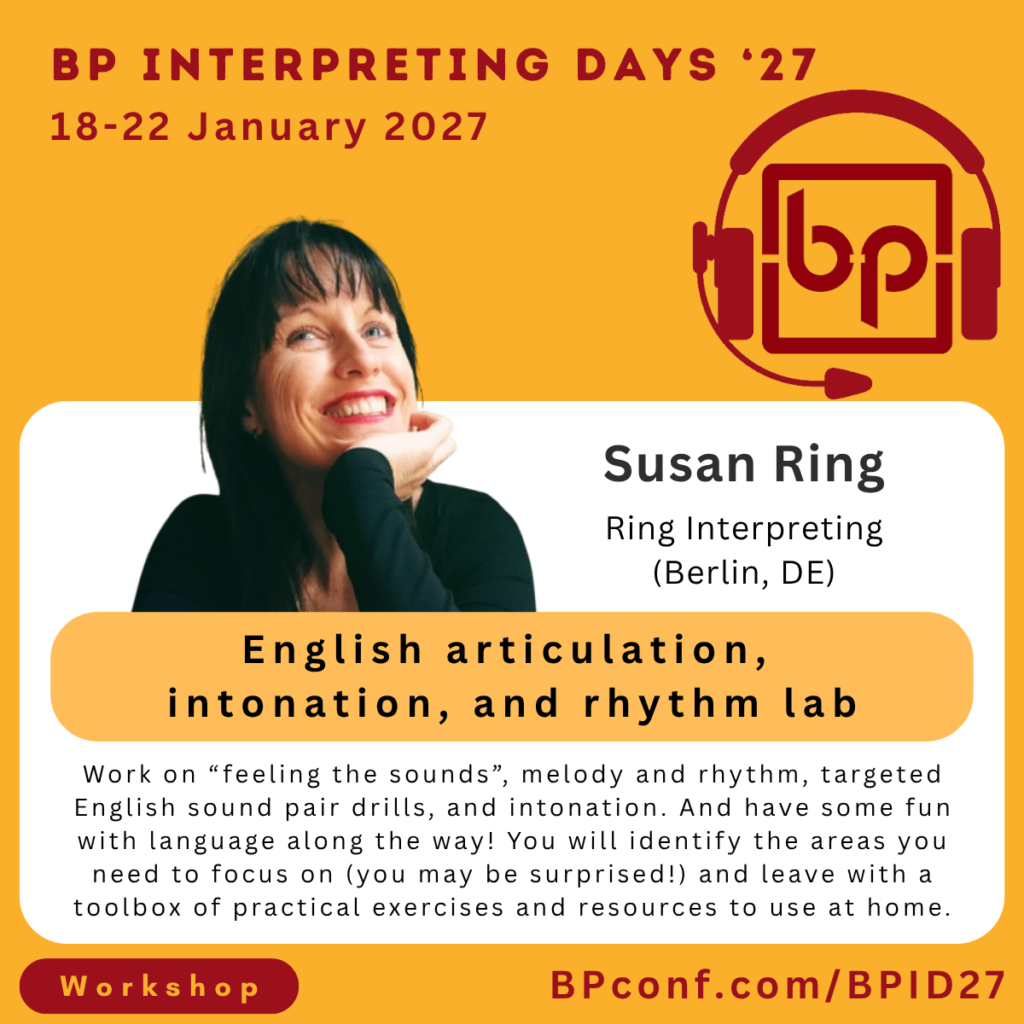
About the session
In this interactive workshop we will focus on how you sound, how clearly you articulate, and how you can use rhythm and intonation to up your English game. You will become aware of the areas you need to work on (you may be surprised!) and leave with a toolbox of practical exercises and resources to use at home. And it will be fun!
We’ll work on “feeling the sounds”, melody, rhythm and pacing techniques, targeted English sound pair drills, as well as intonation and melody.
About the speaker
Susan Ring has been working in the field of language and international communication for over 20 years. After studying translation and interpreting in Cologne, she worked as a conference interpreter for many years and taught at the Institute for Translation and Multilingual Communication, also in Cologne. Today, she lives in Berlin and runs her own translation agency. She is also a language coach who helps language professionals refine their English articulation, intonation and rhythm skills.
https://ringinterpreting.com
https://www.linkedin.com/in/ringinterpreting/
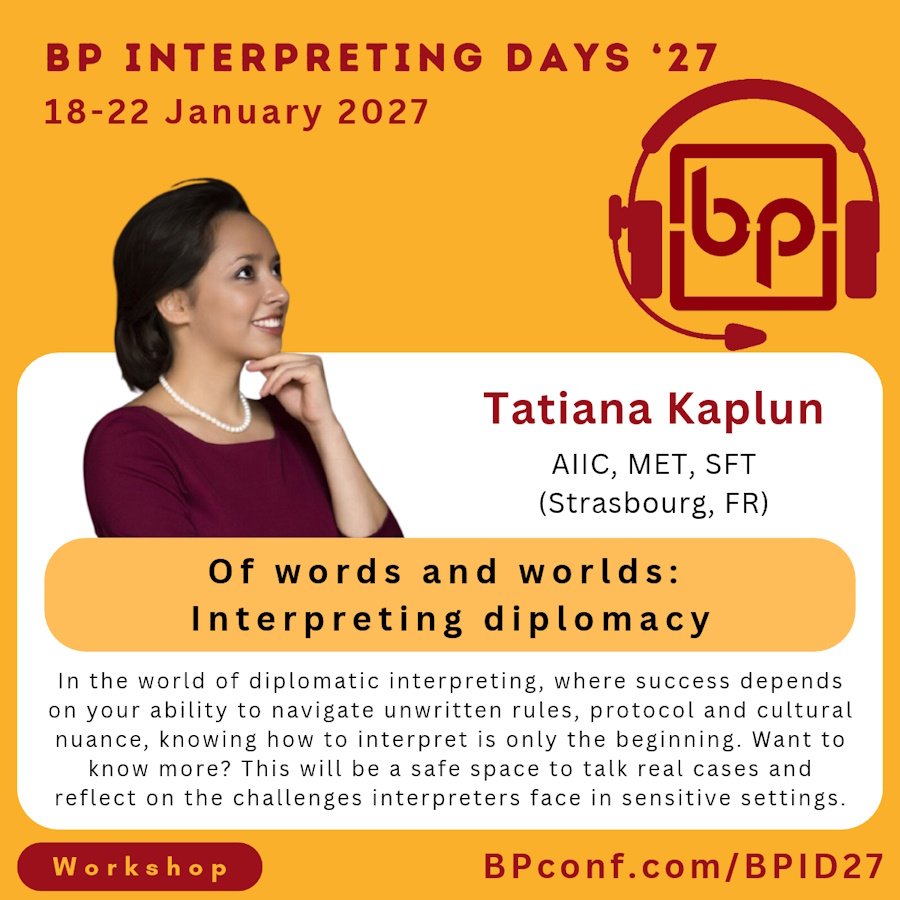
About the session
In the world of diplomatic interpreting, knowing how to interpret is only the beginning. If you want to survive – and thrive – not just among interpreters, but alongside seasoned diplomats and civil servants alike, success also depends on your ability to read the room and navigate protocol, cultural nuance and unwritten rules that shape every interaction. How do you find your place in these complex environments? How do you handle the unexpected, avoid missteps and strike the right balance?
Want to know more? This workshop will be a safe space to explore real-life cases, talk best practices and reflect on the challenges of interpreting in sensitive and diplomatic settings. The icing on the cake? Quite a few of the strategies we will be covering can be applied to other settings as well. We shall also talk about ethics, confidentiality, and how to navigate the field's stress and uncertainty without undermining your health and well-being. After all, the goal is to thrive, not just survive.
About the speaker
Tatiana Kaplun is a Strasbourg-based conference, business & diplomatic interpreter with more than a decade of experience in the field, a committed conference interpreter trainer (ITIRI, University of Strasbourg, CCIC), and an onsite/online meeting consultant. Accredited with several international organisations, she has extensive experience working on the ministerial level and on the private market. She holds a PhD in Conference Interpreting and Intercultural Communication (University of Strasbourg), and an M.A. Interpreting and Translating (University of Bath). Member of AIIC and French regional representative to the AIIC Vega Network, she launched the the AIIC France Mentoring Programme in 2022-2023 and has been running it since. She is also a member of C.R.E.T.A., MET and the SFT, and an accredited court interpreter. A committed interpreter trainer, she dedicates much of her time to T&I research, with a particular interest in diplomatic and legal interpreting, human agency, cognitive load, vicarious trauma and interpreter training, as well as how these areas are being impacted by technology.
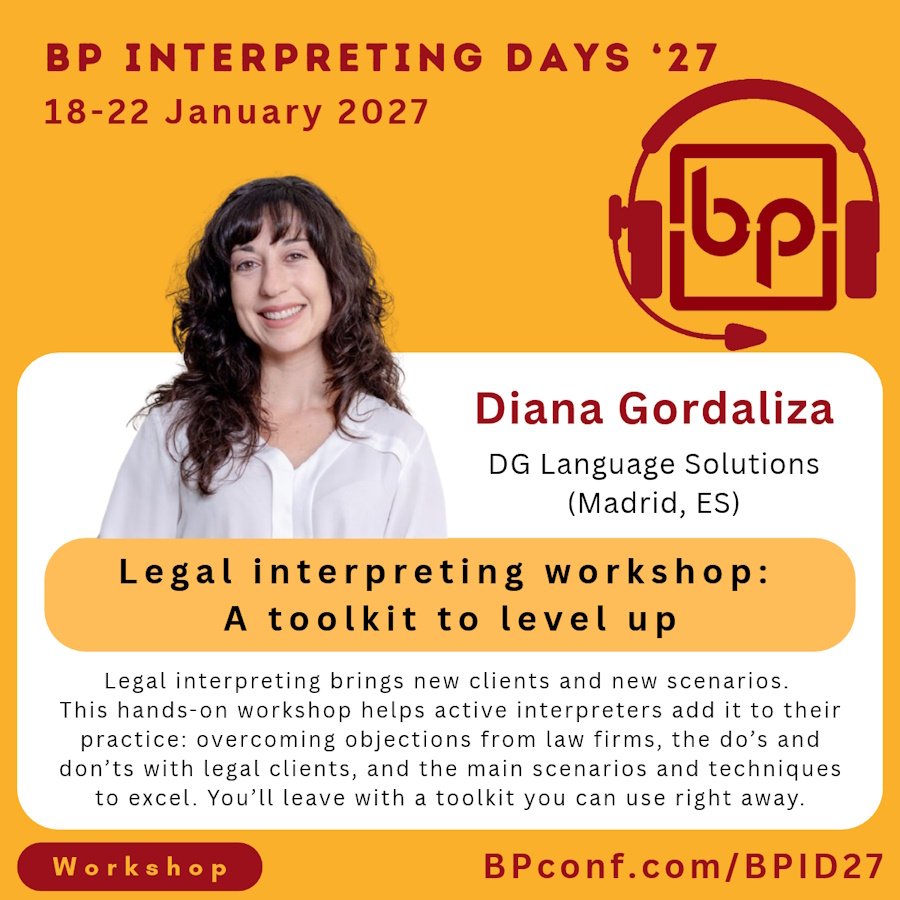
About the session
I stumbled into legal interpreting without a manual, and learned the hard way what works and what doesn't with law firms as direct clients. The legal sector is very particular; that's likely why it hasn't been shaken up by major changes like AI the way other areas have. But that also means it's hard to figure out on your own.
I wish someone had handed me a toolkit back then instead of leaving me to work it out by myself. That's why I'm proposing this workshop: to help fellow interpreters who already have a specialisation navigate this particular niche. It's practical, hands-on content rather than theory for theory's sake: client avatars, real scenarios, techniques and terminology they can put to use right away.
I spoke at BP26 and moderated the closing panel, and I know this audience well. Out of all the events I speak at, BP is one of my favourites, it's the most practical and to the point I've come across, and I genuinely love it.
About the speaker
Diana is the founder of DG Language Solutions and a sworn EN><ES translator and conference interpreter specialising in legal work. She splits her work between two areas: translation and interpreting for law firms and corporations, and business development consulting for LSPs, freelancers and service businesses, often working directly within her clients' teams.
After a decade in the UK, first as a freelance linguist and later in aviation, she relaunched her business in early motherhood. This experience sparked a passion for marketing and business strategy, and a belief that there is a better, more sustainable way to grow a business.
That belief led her to found Emprendebaby, a network to support parents building businesses, and now drives her consulting work. She speaks regularly at conferences and webinars across the language services industry about real-world strategy, down-to-earth marketing and work-life balance.
Diana is a mum of three (and a dog), a coffee lover, and a running geek.
About the session
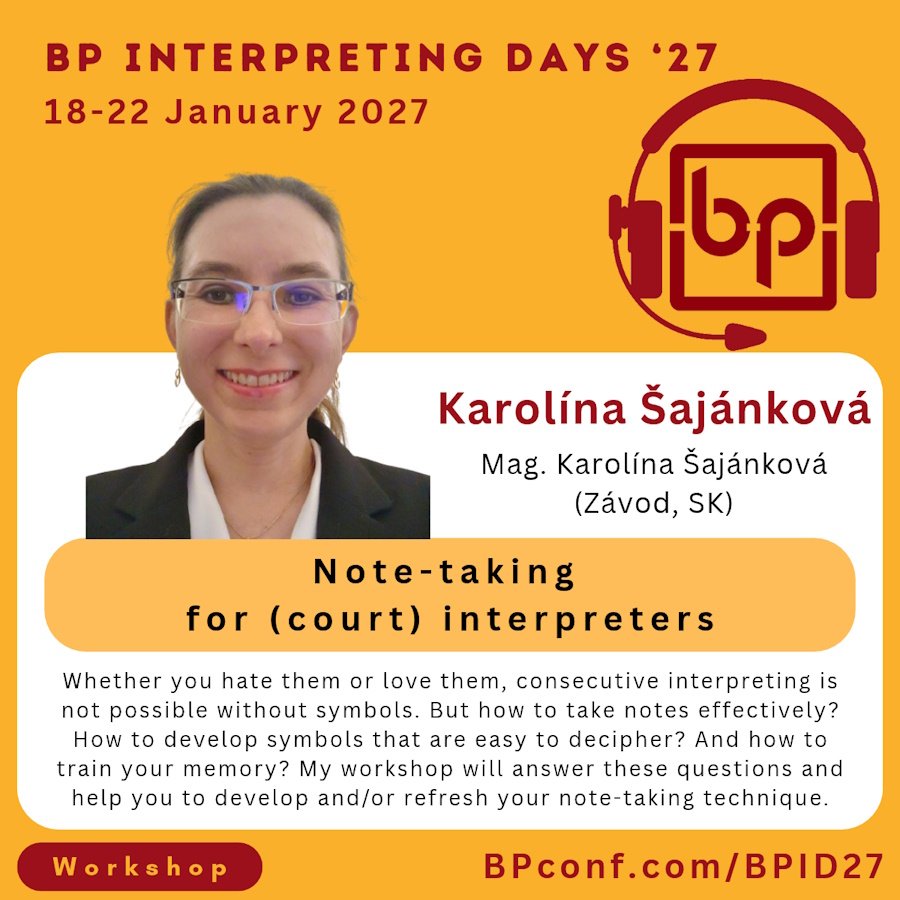
Whether you hate them or love them, you cannot do consecutive interpreting without symbols. But how to take notes most effectively? How to develop (language-neutral) symbols that are easy to remember and decipher? And how to train your memory to deliver high-quality consecutive interpretation? My workshop will answer these questions and help you to develop and/or refresh your note-taking technique. Let’s dive together in the fascinating world of lost symbols!
Consecutive interpreting assignments require good memory, effective note-taking techniques, and symbols that are easy to decode. The first part of my workshop will include a brief introduction into general best practices of consecutive interpreting (e.g. consecutive basics, page structuring, memory training etc.). The second part will focus on the development of useful (language-neutral) symbols for (court) interpreting and note-taking exercises with active participation of the attendees. The participants will leave the workshop with hands-on consecutive experience and ready-to-use solutions to frequent note-taking challenges.
About the speaker
Karolína Šajánková is a court translator and interpreter for English, German, and Slovak with 18 years of experience. She is based in Slovakia and specialises in law, business, and tourism. Her profound legal knowledge comes from many CPD courses like the BDÜ’s Summer school on German legal system, Legal English Course by Oxford Royale Academy, and the Vienna Legal Language Proficiency Exam. Over the years of court interpreting, she has gained considerable expertise in note-taking based on special symbols used in this specific setting, where correct terminology and accuracy are of utmost importance. Karolína believes that the AI boom will inevitably lead to urgent need of classic education. She organises legal English workshops at the Constantine the Philosopher University in Nitra (Slovakia) and held a webinar on German and UK civil and criminal law for Arizona translators in 2023.
www.sajankova.sk
https://www.linkedin.com/in/karolina-sajankova/
About the session
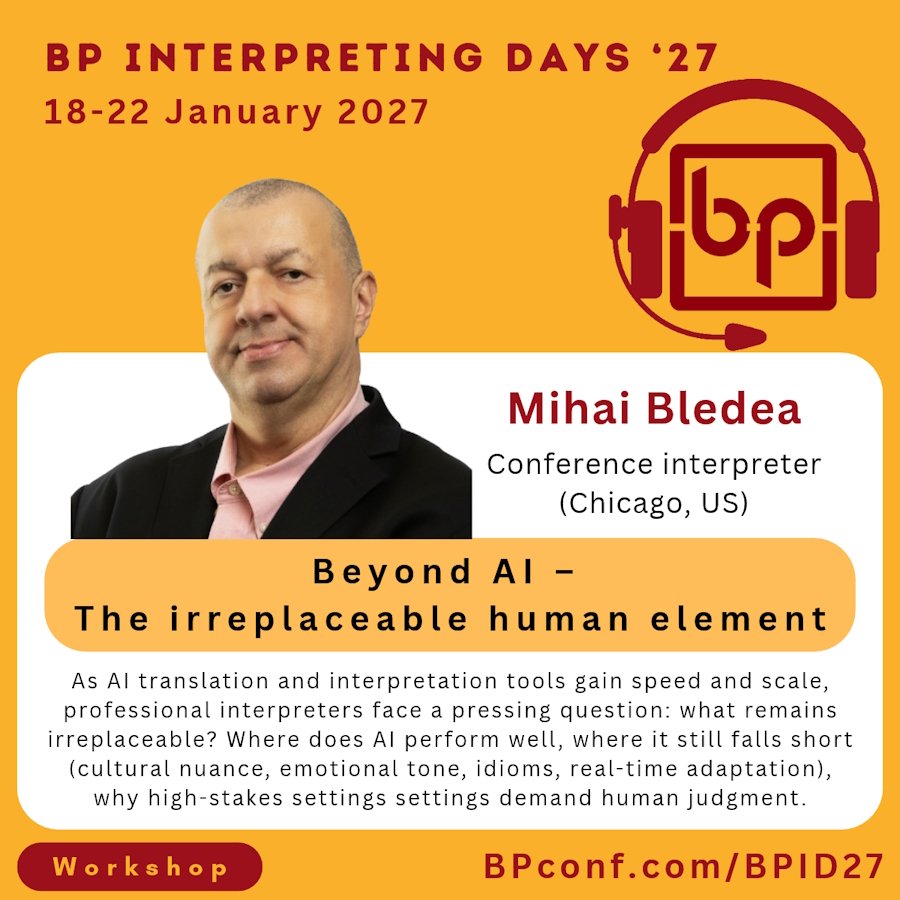
As AI translation and interpretation tools gain speed and scale, professional interpreters face a pressing question: what remains irreplaceable? This presentation examines where AI performs well, where it still falls short (cultural nuance, emotional tone, idioms, real-time adaptation), and why high-stakes settings such as medical, legal, diplomatic and live-event interpreting demand human judgment.
The session confronts the ethical dilemmas AI creates for the profession: accuracy versus efficiency, confidentiality when using cloud-based tools, disclosure to clients, and professional identity. It then offers practical techniques, including cognitive load management, structured cultural mediation, and a three-stage hybrid workflow of AI-assisted preparation, human-led interpretation, and AI-supported review. Attendees will leave with concrete strategies for building specialization, articulating their value to clients, and upholding the ethical standards that keep the human element at the center of interpreting.
About the speaker
Mihai Bledea is a Federal Court Certified Interpreter and Immigration Consultant based in Chicago, Illinois, with more than thirty years of professional experience interpreting and translating in Romanian, French, and English. His career spans forensic, legal, diplomatic, medical, and conference settings. He holds certifications from DOJ/EOIR, CCHI, NAJIT, and the Administrative Office of the Illinois Courts, with credentials in both Illinois and Wisconsin. Mihai has interpreted at conferences for organizations including FIFA, INTERPOL, UNESCO, the World Bank, and the European Parliament. He also serves as an independent contractor under the DOJ EOIR Language Services contract. This breadth of experience gives him a practical perspective on the demands interpreters face in high-stakes, real-world conditions.
He is currently pursuing doctoral research at Babeș-Bolyai University in Cluj-Napoca, studying the impact of artificial intelligence on simultaneous interpretation through a framework he calls “Cognitive Fidelity.” His work explores how interpreters can preserve accuracy, nuance, and professional judgment as technology reshapes the field. Mihai is active in the global language community through ProZ, NAJIT, and LinkedIn. At the BP Interpretation Days on January 21, 2027, he will join remotely to share insights drawn from three decades at the center of the profession.
About the session
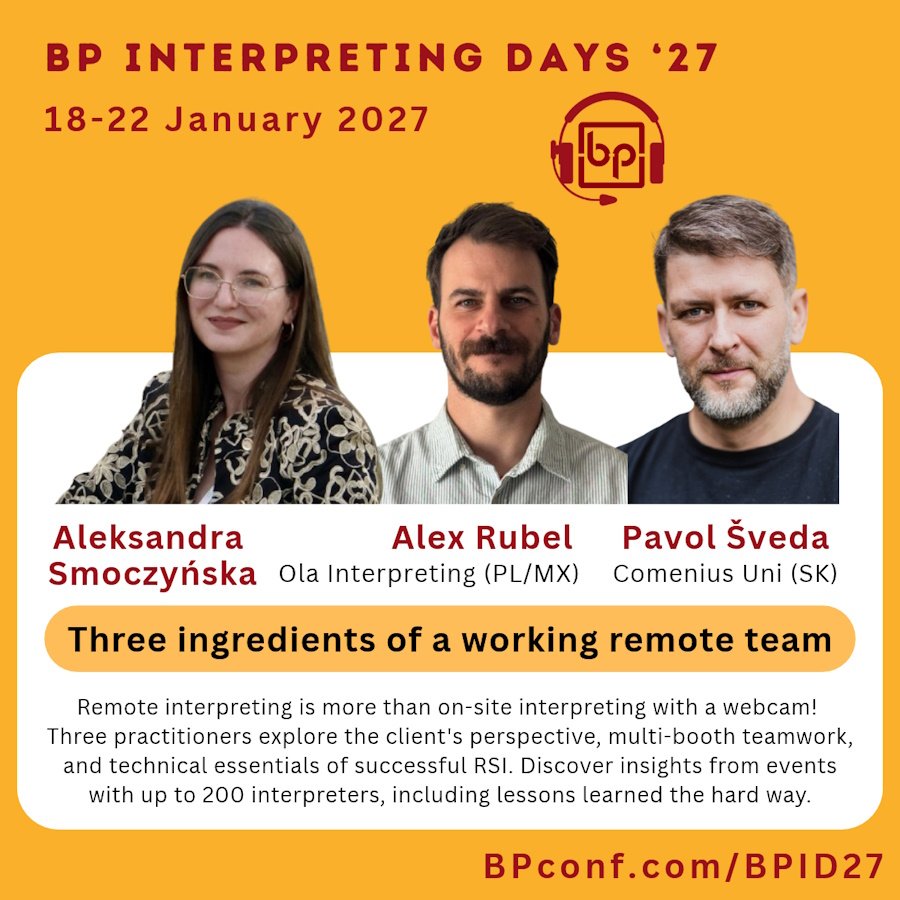
Remote interpreting is not on-site interpreting with a webcam attached, and both sides of the contract feel the difference. Three practitioners walk you through an RSI setup: how it looks from the client's end, what makes a multi-booth remote team genuinely succeed together, and which technical ingredients decide whether the whole dish holds. Drawn from hundreds institutional and corporate meetings with up to 200 interpreters connected, and from a few things we learned the hard way.
---------------------------------------------------
Aleksandra Smoczyńska is an interpreter, entrepreneur and researcher specialising in multilingual communication, interpreting technologies and international event management. She is the Founder of OLA Interpreting, a language services company delivering large-scale onsite, remote and hybrid interpretation projects for international institutions and corporate clients. With almost ten years of industry experience, she has managed complex multilingual operations for organisations including the European Union, United Nations and NATO, coordinating hundreds of interpreters across languages, locations and time zones. Combining hands-on industry experience with academic research, she is passionate about making multilingual communication more accessible, innovative and inclusive.
About the speaker
Alex Rubel is a Chief Technical Operations Specialist and interpreting technology expert, specialising in the technical delivery of large-scale institutional conferences and high-profile international events across onsite, remote and hybrid environments. He has trained and prepared hundreds of interpreters for remote assignments, while designing, implementing and overseeing the technical infrastructure behind complex multilingual operations. From selecting interpreting platforms and optimising audio quality to managing audiovisual systems, connectivity and onsite technical teams, Alex ensures that technology supports interpreters rather than standing in their way. Combining hands-on engineering expertise with a deep understanding of interpreters' needs, he develops tailored technical solutions for demanding multilingual environments. His experience offers a unique perspective on what happens behind the scenes of successful interpreting operations, and why even the smallest technical decisions can make or break an event.
------------------------------------------------
Pavol Šveda combines professional conference interpreting with his role as associate professor at Comenius University in Bratislava. His academic work explores how interpreters are trained, how curricula evolve and how new technologies can support interpreter education. He has published extensively on interpreting pedagogy and the profession’s changing demands. His interpreting experience includes assignments for EU institutions and the Council of Europe. Since the early days of the pandemic, he has provided remote interpreting for a variety of clients and served as team leader for multilingual events. Bringing together the perspectives of practitioner, trainer and researcher, he connects interpreter education with the practical demands of remote work, team coordination and multilingual communication.
About the session
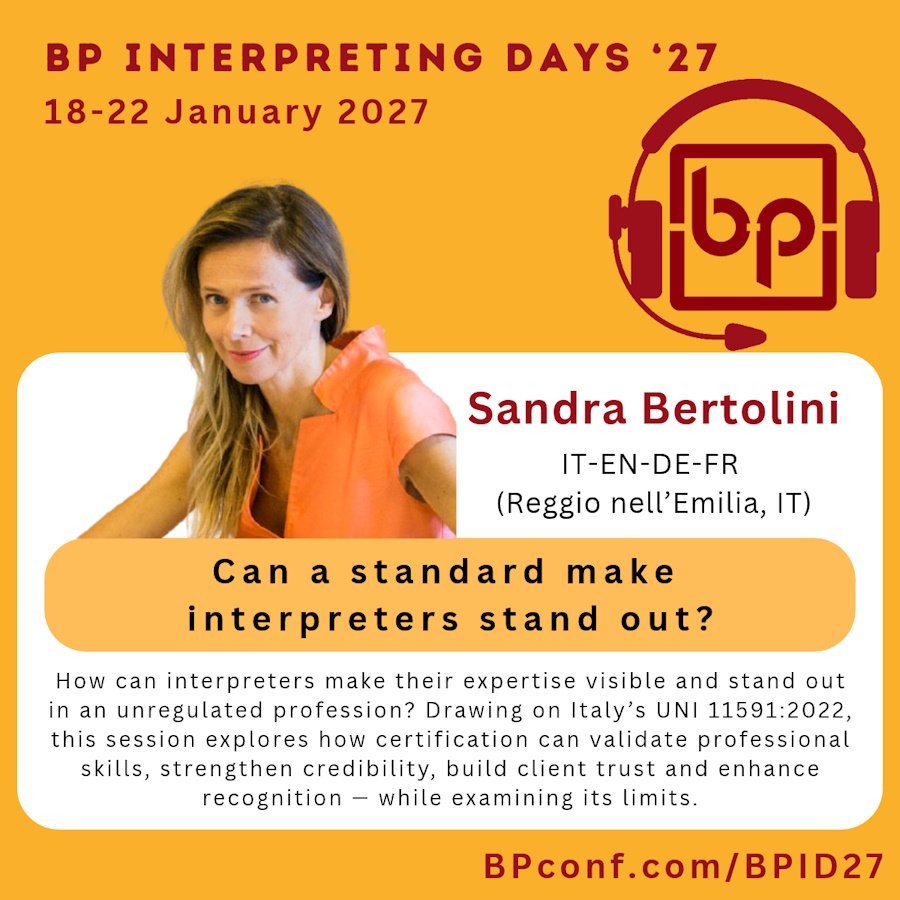
In an unregulated profession, how can clients recognise genuine expertise and how can interpreters make their skills visible? Italy's UNI 11591:2022 turns knowledge, abilities, autonomy and responsibility into assessable requirements. This session explores how certification works, what it can add to professional positioning and where its limits lie, asking whether a shared framework can strengthen trust and give interpreters a stronger voice in a changing market.
About the speaker
Sandra Bertolini is an Italian conference interpreter and certified translator with over 30 years of professional experience, working from English, German and French into Italian. She specialises in education, neuroscience, philosophy and cultural events, interpreting for international conferences, institutions and literary festivals. A qualified member and former National President of AITI (Italian Association of Translators and Interpreters), she actively promotes professional recognition, quality standards and lifelong learning.
She contributed to the drafting of the Italian standard UNI 11591:2015 and its 2022 revision, and currently serves on AITI's Certification Commission, supporting professional assessment and certification processes. Her international experience includes serving on the FIT Council and CEATL contributing to discussions on professional standards and the future of interpreting. Passionate about technology, professional ethics and human communication, Sandra believes that certification can make interpreters stand out by turning professional competence into independently verified, recognisable value.
https://www.linkedin.com/in/sandrabertolini/
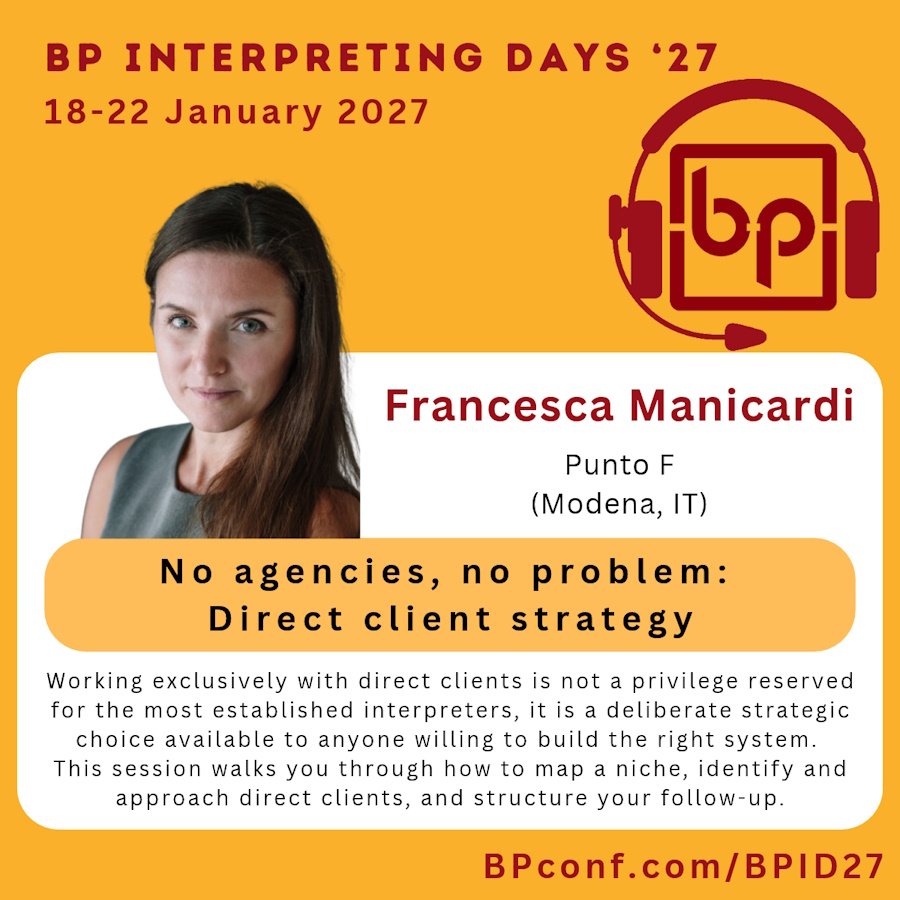
About the session
Many interpreters dream of leaving agencies behind, yet few have a clear roadmap for getting there. Working exclusively with direct clients is not a matter of luck or the right contacts: it takes a different mindset and a deliberate infrastructure. I stopped working with agencies years ago, by design, and today I serve private clients, SMEs and multinationals across multiple languages and settings. In this session, I will share the system behind that shift: how to choose and map a niche, identify who actually buys interpreting services within it, approach decision-makers with a relevant message, follow up consistently without being pushy, and turn satisfied clients into a referral network that keeps working quietly in the background. Expect concrete tools, real examples and a step-by-step method you can start applying the day after the conference, whether you are just starting out or ready to reduce your dependence on agencies.
About the speaker
Francesca is an Italian interpreter, translator and copywriter working with English, German and French, owner of Punto F since 2014. Her fields of expertise are weddings, marketing, tourism, food and wine, beauty and fashion. She wanted to share her knowledge and experience as a freelancer and business owner, that’s why she founded the Freelance Lab, the first Italian mentoring program for wannabe freelance translators and interpreters. She is active on social media and on Freelance Lab’s blog (in Italian), where she shares bright and bad sides of daily freelance life. She was invited to give speeches during many international conferences for interpreters and translators, as BP Conference, LEO Conference and ATA Conference. She’s a member of AITI, IAPTI, CIOL and ITI.
Find her at www.punto-f.com, www.thefreelancelab.it or on LinkedIn and Instagram.
More sessions will be added soon
Also by BP Translation Conferences
Social media
Follow us for more updates
About BP Translation Conferences
The conference was a success, and it grew into a series of annual events, each year in a different country in Europe.
Since 2020, we started to organize online events as well. By now, at over 20 events (online and off combined), we’ve had freelance translators from well over 70 countries around the world.
We are determined to create events for freelance translators to share their expertise grow their professional network… and have fun while doing it.