
FinLex26 :: Translating finance and law :: Multilingual online event :: 3-6 November 2026
Online event on financial and legal translation
market :: trends :: pricing :: techniques :: specialisations
4 days of sessions & workshops
by BP Translation Conferences
FinLex :: 3-6 November 2026
Online event
Countdown to FinLex26
Day(s)
:
Hour(s)
:
Minute(s)
:
Second(s)
4 days of learning and networking
Whether you’re you are a seasoned financial or legal translastor, or just starting out, you’ll find plenty of valuable (and invaluable!) information at FinLex26.
Event format
All sessions and workshops will take place on Zoom, with speaker delivering their content in real time. You’ll be able to ask questions. You need to have a Zoom account to attend.
Recordings
With a Premium ticket, you’ll have access to all recordings and transcripts, so you’ll be rewatch the sessions and workshops for future reference.
FinLex26 :: Registration
38€ to 98€ :: Details
- Full access to all sessions and workshops
- Networking sessions
- Recordings
- Certificate of attendance
- 20% of your spending credited to your account for future purchases if purchased by 30 September
- Read VAT info in the FAQ section below
139€ to 169€ :: Details
- VIP ticket price = 50% of Premium ticket + 120€ (for a 150€ store credit) + video access for free (+ VAT, if applicable)
- Full access to all sessions and workshops
- Networking sessions
- Recordings
- Certificate of attendance
- 10% additional store credit if you purchase by 30 September
- Access to 100+ BP videos, including dozens of workshops (2022-26)
- Access to an additional 200 BP videos, only until November 2026 (2016-21)
- Access info will be available by 7 September.
- Read VAT info in the FAQ section below
VAT on tickets to online events
Tickets to online events are regarded as digital services for taxation purposes. We sell such tickets through EU’s OSS mechanism, using the following VAT rates:
- EU customers with VAT number: 0% VAT (reverse charge)
- EU customers without VAT number (individuals): their local VAT rate
- Hungarian customers (with or without a VAT number): local VAT rate
- Customers outside the EU: 0%
Important: It makes sense to buy to VIP ticket if you have a European VAT number. For our in-person events, we must charge local VAT, but with a VIP ticket to FinLex26, you’ll get a 150€ store credit without having to pay VAT on this portion of your future ticket.
Geographically differentiated prices
All of our online events (including access to video recordings) are priced with geographical differentiation. The idea is to make our events more affordable for colleagues in lower income countries.
Countries are grouped into 6 categories. For example, translators from Romania pay less than in Germany, or translators from Argentina pay less than in Spain.
If your current location and your billing address don’t match, you may see an error message: in this case, write to us directly.
50% discount for students
At least 2 translation students registering together get a 50% discount off a FinLex26 Pemium ticket.
Details / Application in the form below (or open it here)
Payment in 2 instalments
You have the option of paying for your ticket in two euqal instalments.
You can choose to pay in 2 instalments: Downpayment is 50% of the total, followed by the remaining 50% after a month.
Terms and conditions:
- Only card payment
- Only for orders over 70€
- A 2% surcharge applies
- Select ‘Payment by Partial.ly’ on the Checkout page — you’ll be taken to their page
- Card payments processed by Stripe
FinLex26 :: Programme
Timing of individual sessions/workshops may change
Tuesday, 3 November
13:00 – 16:00 CET

More about the subject / speaker
The work of legal translators often includes cross-border family cases, and therefore it is critical to understand legal concepts of the source/target culture. The workshop has two parts: the first part focuses on a brief intro into the UK and U.S. family law offering a solid theoretical basis followed by the second practical part with exercises, useful templates, and specific terminology. Its target group are seasoned and beginning legal translators with English. The attendants will benefit from increased awareness of legal principles, ready-made solutions for the most frequent language challenges, and hands-on translation templates.
Karolína Šajánková (www.sajankova.sk) is a court translator and interpreter for English, German, and Slovak with 18 years of experience. She specialises in law, business, and tourism. Her profound legal knowledge comes from many CPD courses like the BDÜ’s Summer school on German legal system, Legal English Course by Oxford Royale Academy, and the Vienna Legal Language Proficiency Exam. Karolína believes that the AI boom will inevitably lead to urgent need of classic education. She organises regular legal English workshops at the Constantine the Philosopher University in Nitra (Slovakia) and held a webinar on German and UK civil and criminal law for Arizona translators in 2023.
Thursday, 5 November
13:00 – 15:00 CET

More about the subject / speaker
15:10 – 15:40 CET

More about the subject / speaker
Workiva is a cloud-based platform for financial, governance and sustainability reporting. It brings together data from corporate applications to provide a single source of truth. Workiva documents reference this central source. Documents or sections of documents can be exported in various formats. Workiva supports integrated machine translation and XLIFF export/import for external translation. The file export and import formats have limitations that can present difficulties for translation workflows. The translation of a finished report requires setting up a language project in Workiva, its export as XLIFF, its translation, and its import back into the platform. The translator needs the exported XLIFF file, and preferably an exported PDF. User access to Workiva is helpful but not vital in this scenario. The translation of a finished report with updates in the source text requires close coordination between a PM with user access to Workiva or that the translator has the access to handle this themselves. Revision and review of a report with updates in both source and target languages in parallel is the most complex scenario and requires close coordination with the client and access to the source and target texts in Workiva.
Dave Calvert got into the language services industry in the late 1980s. He was one of a group who co-founded an LSP in Cologne, Germany. He originally specialized in scientific translation and the IT side, in particular DTP. A few years later, he co-founded TransForm GmbH, also in Cologne. TransForm specializes in corporate publishing. Its customers include corporate clients and publishers, and the projects mostly cover magazines for internal and external publication, financial and ESG reporting, and general communications and marketing material. He has presented at conferences including Translating and the Computer, tekom, and memoQFest.
Friday, 6 November
13:00 – 15:00 CET

More about the subject / speaker
15:10 – 16:00 CET

More about the subject / speaker
F. A. Q.
Registration / Tickets (Remote)
Ticket types
During the current pre-registration period, only ‘Premium’ tickets are available, covering all sessions and workshops, and giving you access to the recordings as well.
We may have different types of tickets later on.
Geographically differentiated pricing
For all our online events, we use geographically differentiated pricing, making it more affordable to attend for colleagues in lower income countries.
For example, people in Romania pay less than in Germany; people in Argentina pay less than in Spain; and so on.
Prices shown on this page are the highest ones. The price payable in your country will be shown on the Checkout page.
Note: if the country based on your IP address does not match the country based on your billing address, you’ll receive an error message.
(For example, if your billing address is in France, but you’re currently on holiday in Morocco.)
For best results, buy your ticket in your home country — or send us a message with your billing address and the type of ticket you’d like to buy, and we’ll issue an invoice manually.
How do I register for the conference?
You can buy the ticket of your choice on this page, above.
You will receive the necessary access information 3 weeks before the online edition, and you’ll also receive reminder emails.
Can I really attend for free?
You’ll be able to sign up for free access. This will cover a single track, with probably 3-4 sessions.
More details, including the actual tracks, will be available from July.
In the meantime, it’s a good idea to sign up to our mailing list.
VAT
Remote attenance at online events is considered a digital service, and is taxed as such.
If you’re from the EU, with a VAT number:
- You’ll pay the net amount, following the reverse charge VAT mechanism
If you’re from the EU, without a VAT number:
- You’ll pay your local VAT on top of the net price (e.g. 20% in France, 23% in Italy, etc.)
I you’re from Hungary:
- you’ll need to pay Hungarian VAT
If you’re from outside the EU, and you purchase as a company:
- You’ll pay only the net amount
If you’re from outside the EU, and you purchase as an individual:
- you’ll need to pay Hungarian VAT
Invoicing
Remote tickets will be invoiced with our Hungarian VAT number. Remote attendance is considered a digital service.
If you are based in the EU and you have a VAT number, you will pay the net amount (reverse charge VAT). If you are based in the EU and you don’t have a VAT number, you’ll need to pay your local VAT on top of the net price.
If you are outside the EU, you’ll pay the net price.
Deposit invoice vs Final invoice
You’ll first receive a ‘deposit invoice’ when you pay for your ticket. You can use this for accounting purposes.
Once the event is over, we need to issue a so-called ‘final invoice’: this will have a total 0€, and you probably won’t need it anyway, but we need to issue to comply with Hungharian regulations.
Where does my money go?
Revenue from remote ticket sales is used to cover our ongoing expenses of running BP Translation Conferences.
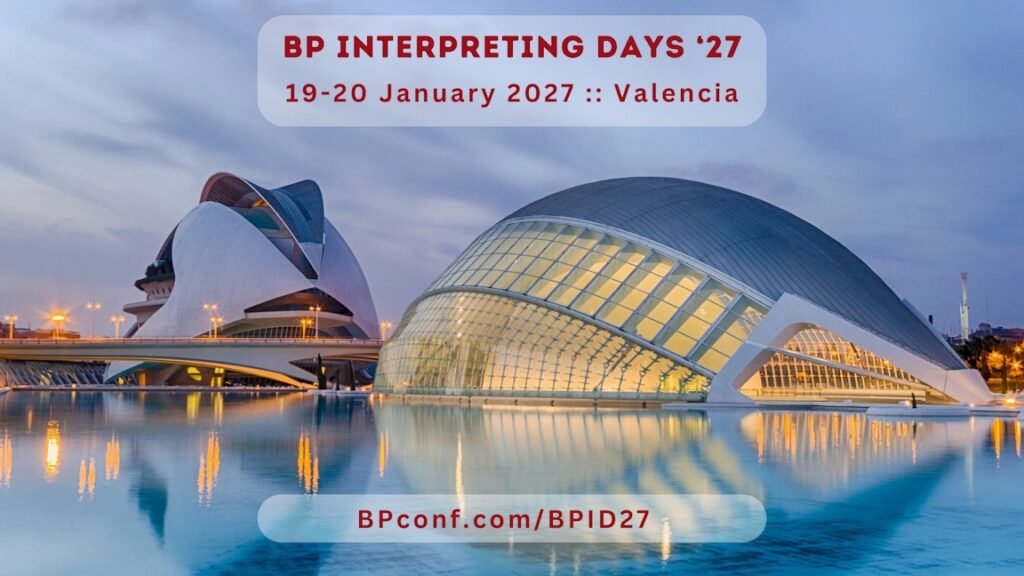
Also by BP Translation Conferences
Social media
Follow us for more updates
About BP Translation Conferences
The conference was a success, and it grew into a series of annual events, each year in a different country in Europe.
Since 2020, we started to organize online events as well. By now, at over 20 events (online and off combined), we’ve had freelance translators from well over 70 countries around the world.
We are determined to create events for freelance translators to share their expertise grow their professional network… and have fun while doing it.